Free in-home estimate · We bring the samples
Floor removal, subfloor prep and repairs
Most flooring problems we are called to fix trace back to the subfloor: hollow spots, squeaks, cracked tile lines and gaps. We remove the old floor, deal with what is underneath and get it flat and dry before anything new goes down.
- Samples brought to your home
- Every room measured at the visit
- Materials and installation in one written quote
- Professional installation
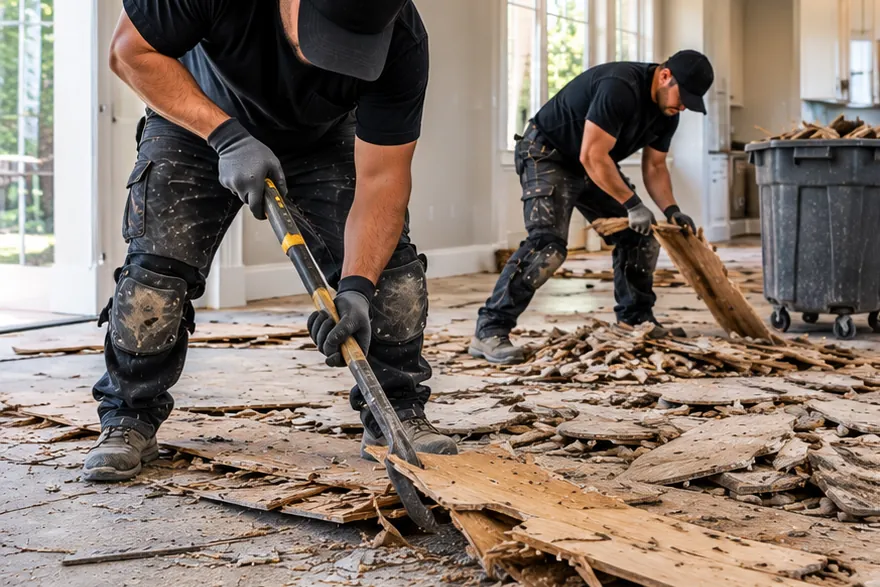
Illustration only, not a photo of a Los Angeles Hardwoods project.
We also repair damaged boards in existing hardwood and weave in new pieces where possible.
How it works
1. Tear-out
Carpet, tile, vinyl or wood removed and hauled away.
2. Inspect
Moisture readings, flatness checks and a look for damaged plywood.
3. Correct
Grinding high spots, leveling low spots and replacing or re-fastening subfloor panels.
4. Ready for install
A flat, clean subfloor that meets the new floor's installation requirements.
Repair or replace hardwood?
Isolated damage such as a few stained, cracked or water-marked boards can often be cut out and replaced with matching boards, then blended in. If damage is widespread, boards are cupped from moisture, or the wear layer is too thin to sand again, replacement is usually the better value. See flooring replacement.
Removing existing flooring before installation
Carpet and pad come out quickly, but tack strip and staples have to be pulled. Floating laminate and vinyl lift out in rows. Glued-down vinyl and glued hardwood take longer, and leftover adhesive often has to be scraped or ground before the new floor goes in. Tile is the most involved: tile, thinset or a mortar bed are removed and the surface is ground flat. Nailed hardwood is pulled board by board and the subfloor checked for damage underneath.
The type of removal affects the schedule and the quote, so we identify it at the estimate. Once the old floor is out, the subfloor is prepared for the floor going in: hardwood, laminate, luxury vinyl plank or tile.
Concrete subfloor grinding and self-leveling
Every manufacturer sets a flatness tolerance for its floor, often a small amount over a 6- or 10-foot span. On concrete, high spots and ridges are ground down, and low spots or dips are filled with a patch or a self-leveling underlayment. The tolerance of the floor you choose decides how much of this is needed: rigid planks and large tile are less forgiving than thin glue-down products, and wide planks need more than narrow ones.
Plywood subfloor repair and preparation
Over raised foundations and second floors, we look for water-damaged or delaminated plywood, loose panels and squeaks. Damaged sections are cut out and replaced, loose panels are re-fastened with screws, and seams are leveled. The subfloor has to be stiff and flat enough for the new floor, especially for tile and nail-down hardwood.
Moisture testing before flooring installation
Moisture is the main cause of cupped hardwood, failed adhesive and mold under floors. Concrete slabs are tested with the method the flooring manufacturer specifies, such as in-slab relative humidity probes or calcium chloride tests, and wood subfloors are checked with a moisture meter. If readings are too high, the fix may be a moisture-barrier adhesive or underlayment approved by the manufacturer, or more drying time before installation.
How moisture and flatness affect the choice between glue-down and floating floors is covered in our guide to engineered hardwood over concrete.
Preparation vs. repair-only work
Most of the work on this page happens as part of a new floor or a refinishing project. If you only need a repair, such as replacing damaged hardwood boards, ask us; we look at it at the free estimate and tell you whether a repair, refinishing or replacement makes the most sense.
Related flooring and services
Questions we hear
Why does subfloor flatness matter?+
Every manufacturer sets a flatness tolerance in its installation guide. Floors laid over dips and humps can flex, separate or void the warranty.
Can you remove tile?+
Yes, including tile set on mortar beds, followed by grinding and leveling.
Recent projects
We bring the showroom to your doorstep
We bring samples to your home, measure your rooms and give you a written quote. The estimate is free.